 Understanding the core principles of Montessori Elementary Education.
Between the ages of six and twelve, something extraordinary happens inside a child. The quiet, sensory driven explorer of the early years transforms into a fiercely curious, social, and deeply imaginative thinker. This is not a transition to manage, it is a force to be harnessed. At Amaya Montessori School, our Elementary programme is built around exactly this insight, shaped by the timeless principles Maria Montessori observed and articulated over a century ago.
This blog explores the foundational principles that define Montessori Elementary education and why they matter profoundly for the children in your care.
1. The Second Plane of Development
Montessori described human development in four distinct planes, each with its own psychological characteristics and sensitive periods for learning. The Elementary years, ages 6 to 12 form the Second Plane. Where the child of the First Plane (birth to 6) is driven by direct sensory experience and the construction of self, the elementary child is driven by an equally powerful force: the herd instinct and the reasoning mind.
Elementary children want to belong to a group. They crave fairness, justice, and moral clarity. They ask ‘why’ constantly and passionately. They want to understand not just how the world works, but why it exists as it does, how it came to be, and where they fit within it.
Montessori Elementary is designed to answer this call. It offers a prepared environment for this new kind of child — social, imaginative, and morally awake.
2. Cosmic Education: The Universe as the Curriculum
At the heart of Montessori Elementary is the concept of Cosmic Education. Rather than presenting isolated subjects like mathematics here, history there, science over there, Montessori offers children the whole story: the story of the universe, of life, of human civilisation, and of the individual self within all of it.
This grand narrative is introduced through the Five Great Lessons:
These are not just lessons — they are invitations to wonder. Each great lesson opens up dozens of threads for exploration: a child captivated by the story of life may dive deep into biology; another, moved by the story of numbers, may spend weeks exploring ancient number systems. The curriculum radiates outward from these stories, always connected, never siloed.
Cosmic Education teaches children that they are part of something vast and meaningful and that every subject they study is a window into that larger whole.
3. Freedom Within Structure
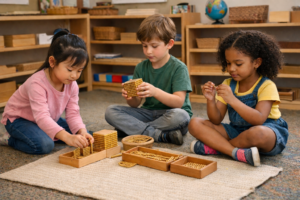
A visitor to our Elementary classroom might be surprised by what they see – children working in small groups, some on the floor with charts and materials, others at tables writing, a few in lively discussion in a corner. The teacher moves between them observing, guiding, offering a question here, a new material there.
This is freedom with responsibility — one of Montessori’s core principles. Children are free to choose their work within a framework of lessons given by the guide. They manage their own time, collaborate with peers of different ages, and follow their intellectual interests in depth. In doing so, they develop self-regulation, initiative, and intrinsic motivation — qualities no worksheet or timetable can manufacture.
The structure is not the schedule. The structure is the prepared environment, the carefully sequenced curriculum, and the trust placed in the child’s natural desire to grow.
4. The Mixed-Age Community
In our Elementary environment, children aged 6 to 9 (Lower Elementary) and 9 to 12 (Upper Elementary) share time, space, and learning. This is not a compromise — it is a deliberate design.
When a younger child watches an older peer present a report on the Roman aqueducts, something happens that no textbook can replicate. And when an older child explains long division to a younger one, they consolidate their own understanding in a way that no test can measure. The mixed-age group creates a living social fabric — one in which leadership, empathy, collaboration, and mentorship grow naturally.
This mirrors real community life, where people of different ages work, create, and solve problems together — and it prepares children for exactly that.
5. Going Out: Learning Beyond the Classroom
One of the unique features of Montessori Elementary is Going Out — the practice of small groups of children planning and executing real-world excursions in service of their research. A group studying water systems might visit a reservoir. A group exploring local governance might write to and visit their municipal office. A group researching traditional crafts might find an artisan willing to demonstrate their work.
Going Out develops independence, planning skills, social responsibility, and the understanding that learning is not confined to four walls. The world is the classroom and the elementary child is ready and eager to step into it.
At Amaya, these experiences are woven into the rhythm of the school year and treated with the seriousness and joy they deserve.
6. The Role of the Montessori Guide
The Elementary guide is neither lecturer nor supervisor. They are, as Montessori described, a keeper of the flame — someone whose role is to observe carefully, introduce materials and lessons at the right moment, and spark curiosity that the child then carries forward independently.
This requires deep knowledge not just of subject matter, but of each individual child: their interests, their working pace, their social dynamics, their moment of readiness. A Montessori guide plans not by the clock, but by the child.
At Amaya, our guides undergo extensive AMI-aligned training precisely because this art of careful, responsive teaching is not picked up overnight, it is cultivated over years of study and practice.
An Education Worthy of the Child
The elementary years are often treated as a bridge, a time to get through before secondary school begins. Montessori asks us to see them differently: as a golden period of intellectual formation, social flourishing, and moral awakening.
When a child leaves our Elementary programme at Amaya, they carry with them more than academic skills. They carry the habit of curiosity, the confidence of independence, the experience of deep collaboration, and a sense of their own place in the vast, beautiful story of humanity.
That, we believe, is an education worthy of the child.