
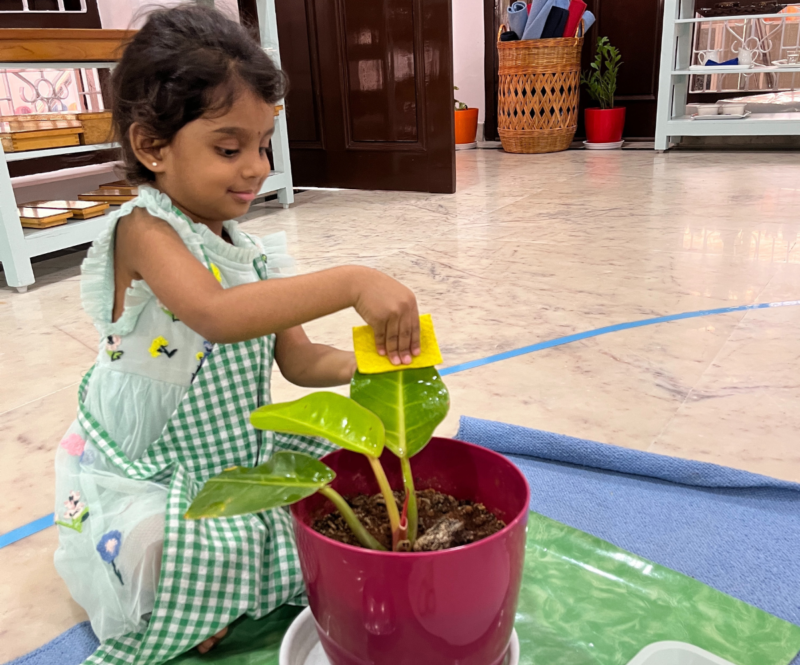
 Care of Plants
I have always been a nature person. Working with plants has been a quiet presence in my life. However, my relationship with nature deepened when I began working with children.
I still remember the first time I showed a child how to gently clean plant leaves. As I demonstrated the movement, slow, careful, respectful, I felt something shift. Something softened, something awakened. That moment marked the beginning of my true passion for plant care.
What began with one plant grew into two, then many more. Soon, my mother’s terrace became home to nearly fifty plants. Moreover, spending time with nature grounds us profoundly. It opens something within while anchoring us firmly in the present moment. Consequently, as my connection with plants grew, so did their presence in my Montessori environment.
What is Care of Plants in Montessori Education?
In Montessori settings, Care of Plants is essential to Care of the Environment activities. Children are naturally drawn to living things and love meaningful work, especially when it involves nature. Furthermore, these activities teach responsibility while cultivating environmental awareness.
We begin simply with basic plant care activities:
- Cleaning leaves with gentle movements
- Cutting dried or damaged leaves carefully
- Watering plants with appropriate amounts
- Loosening and aerating soil to help roots breathe
- Pruning for healthy growth
These activities are never rushed. Each movement is shown with intention. Therefore, children understand that plants are living beings requiring care, respect, and consistency.
The Benefits of Plant Care Activities
Developing Responsibility and Awareness
Through plant care work, children develop awareness of life around them. Additionally, they build a sense of responsibility towards living things. There is also a strong aesthetic element. Children begin to notice beauty, healthy leaves, fresh growth, and quiet transformation. As a result, caring for something regularly creates lasting impact.
Plant care activities cultivate responsibility and empathy by embedding care within daily routines, presenting structured yet accessible developmental challenges.
Building Fine Motor Skills and Concentration
Plant care naturally develops essential skills:
- Coordination: Handling small watering cans and tools
- Concentration: Focusing on delicate tasks
- Independence: Completing activities without adult’s help
- Patience: Observing slow growth over time
Activities like trimming dead leaves or measuring water, enhances concentration by focusing on detailed tasks.
Connecting Learning to Real Life
As children grow in experience, connections form naturally across learning areas. When they work with the Botany Cabinet, learning names and shapes of leaves, this knowledge comes alive during plant care.
While cleaning leaves, children often identify shapes they recognize, ovate, lanceolate, or heart shaped. This makes learning purposeful and concrete. Similarly, botanical vocabulary becomes meaningful through hands-on experience.
One beautiful outcome of plant care work is how it extends beyond school. When children engage deeply with activities at school, they carry them home.
Families who never cared much about plants often become interested. Why? Because their child wants to water plants, clean leaves, or grow something small on the balcony. Slowly, children become teachers and adults become learners.
This reflects a powerful truth: we are deeply interdependent. Learning flows both ways.
Teaching Children Respect for Living Things
Children are natural explorers. When first introduced to plant care, many perform activities with great care. At times, exploration may go too far, a plant uprooted, fresh leaves cut in curiosity.
While these moments can feel sad, they become opportunities for meaningful conversation. Through group discussions, children reflect together. Moreover, they develop empathy and understand the impact of their actions.
Often, children express genuine remorse. They show a deep desire to care better next time.
Nature as the Best Teacher
Nature itself becomes the best teacher. Some children notice tiny eggs in the garden area. They return every day to observe. Furthermore, they wait patiently as caterpillars emerge, transform into chrysalis, and eventually become butterflies.
These experiences cannot be replicated through books alone. They spark:
- Wonder at life’s transformations
- Patience through observation
- Respect for all living creatures
- Scientific curiosity about natural processes
Gardening provides children with opportunities to understand ecosystems and learn about the interdependence between plants, animals, and humans.
Plant Care Activities for Children
One simple plant care activity offers so much more than it appears. As a child’s interest deepens, the guide may introduce:
Activities – Ages 2-3
- Watering with small pitchers
- Cleaning large leaves
- Observing plant changes
Activities – Ages 3-4
- Names of common plants
- Identifying plant parts
- Gentle pruning with supervision
Activities (Ages 4-6)
- Herb garden care
- Simple kitchen gardening
- Understanding plant needs (sunlight, water, soil)
Step by step, children build relationships with nature. These relationships are rooted in experience, curiosity, and genuine care.
Dr. Maria Montessori believed that education is a natural process carried out by the child. Moreover, she understood that the adult’s role is to prepare an environment where meaningful work is possible. Care of Plants offers exactly this, real work with real purpose. When children engage in plant care, they nurture more than living things. Additionally, they cultivate:
- Concentration through focused activity
- Independence through self-directed work
- Coordination through precise movements
- Inner discipline through consistent care
These activities support the development of the will and help children move from unconscious exploration to conscious care.
The prepared environment, combined with respectful guidance, allows children to experience themselves as capable contributors. Therefore, plant care becomes more than a task, it becomes meaningful participation in life.
Importance of Plant Care
I believe that when children learn to care for plants, they learn to care for life itself. Nature nurtures the child. In turn, the child learns to nurture the world around them.
This reciprocal relationship forms the foundation of environmental consciousness. Furthermore, it builds the empathy and responsibility our world desperately needs.
Through simple, consistent Montessori plant care activities, we raise children who:
- Understand their connection to nature
- Respect all living beings
- Take responsibility for their environment
- Appreciate beauty in everyday moments
- Develop patience through observation
Written By:
Amina Banu
Co-Founder & Chief Directress
Amaya Montessori House of Children
 Contact us: 9167570955
 Visit: amayamontessori.com
 Location: Road No. 5, Banjara Hills, Hyderabad