
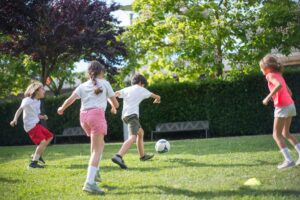
 Watch any child at play, and you’ll witness something extraordinary: a natural scientist conducting experiments, testing hypotheses, and building understanding of their world. This isn’t just adorable — it’s how children are designed to learn. Yet in our modern world, we’re witnessing what social psychologist Jonathan Haidt calls “the great rewiring of childhood,” where screen time has replaced outdoor play and adult supervision has eliminated the very challenges children need to thrive.
As a Montessori educator, I observe daily how movement and free play serve as the foundation for children’s holistic development. The question we must ask ourselves: are we nurturing antifragile children who grow stronger through challenges, or are we creating fragile ones who crumble at the first setback?
What Great Educators Understood About Play?
The pioneers of child development weren’t guessing when they emphasized play’s crucial role. Dr. Sigmund Freud described play as the “royal road to a child’s unconscious,” recognizing how children express their deepest thoughts and feelings through movement and imagination. Dr. Maria Montessori saw play as the natural vehicle through which children explore and understand their world, fostering cognitive, social, and emotional development simultaneously. Friedrich Frobel, kindergarten’s founder, believed play represents the highest expression of human development in childhood.
These educators recognized a fundamental truth: free play isn’t mere entertainment—it’s the primary way children develop the skills they need for adulthood.
The Research Behind Movement and Play
Modern neuroscience confirms what these educators intuited. Research shows that children who engage in unstructured free play develop stronger executive functioning—the cognitive control processes that regulate thought and action in support of goal-directed behavior. According to studies cited by the National Institute for Play, free play promotes cooperation, empathy, emotional regulation, creative thinking, and problem-solving abilities.
Dr. Peter Gray defines free play as activity that is freely chosen, child-directed, and undertaken for its own sake. Physical play outdoors, particularly with mixed-age groups, provides the healthiest and most beneficial form of play. Why? Because it allows children to take risks, negotiate conflicts, and learn from mistakes in real time—skills no classroom lesson can replicate.
The United Nations High Commission for Human Rights has classified free play as a fundamental right, recognizing that activities directed by adults simply cannot provide the same developmental benefits.
The Antifragility Principle
Nassim Taleb’s concept of antifragility perfectly describes what children need: not just resilience to withstand challenges, but the ability to grow stronger through them. Like bones that strengthen under stress, children develop emotional and psychological strength when they encounter age-appropriate difficulties during play.
Jonathan Haidt, in “The Anxious Generation,” explains how the decline of play-based childhood—beginning in the 1980s and accelerating through the 1990s—deprived children of opportunities to overcome normal childhood fears and anxieties. Without chances to explore, test limits, and build close friendships through shared adventure, children never learn to judge risks for themselves.
The small-scale challenges that happen during free play—falling off a swing, negotiating turn-taking, or resolving a disagreement with peers—act as inoculations. They prepare children to face much larger challenges later in life.
What Modern Children Are Missing?
Research reveals alarming trends. Studies show that children have lost an average of eight hours of free play per week over the past two decades. Time spent with friends has declined steeply since 2010, while sleep deprivation has increased. The shift from the physical world to virtual screens has been, as Haidt documents, catastrophic for mental health.
When psychiatrist Stuart Brown studied men incarcerated for homicide, he found a striking pattern: compared to a control group outside prison, these individuals lacked abundant examples of free play in childhood. The connection between play deficiencies and difficulty forming trusting social bonds proved significant.
Creating Play-Rich Environments
As educators and parents, our role isn’t to impose structured learning but to facilitate children’s inherent learning process. Here’s how:
Trust the Process: Children are natural researchers. Their intuitive grace guides environmental exploration in ways that structured activities cannot replicate. Resist the urge to direct every moment.
Embrace Risk: Unsupervised outdoor play has been found to result in less physical harm than adult-supervised sports. Children need to experience minor bumps and bruises to learn how to avoid major injuries.
Reduce Screen Time, Increase Real-World Time: As Haidt notes, if we don’t replace screen time with real-world experiences involving friends and opportunities for independent activity, banning devices feels like deprivation rather than liberation.
Support Emotional Development: Remember that experience, not information, is the key to emotional maturation. Children learn to tolerate bruises, handle emotions, and resolve conflicts through unsupervised, child-led play.
The Path Forward
The solution isn’t complicated, though implementing it requires courage. We must restore outdoor play, mixed-age interactions, and independent exploration to childhood. We must accept that protecting children from every minor setback creates fragility, not safety.
Great educators like Freud, Montessori, and Frobel understood that free play isn’t just a pastime—it’s fundamental to learning, self-expression, and overall growth. Modern research from neuroscientists, psychologists, and developmental experts confirms their wisdom.
Our children deserve the chance to move, explore, fall, get back up, negotiate, create, and discover. They deserve to become antifragile—stronger, more capable, and more confident with each challenge they overcome.
The question is: will we have the courage to let them?
Written by: Debasish K